Optimized matching conditions for self-guided laser wakefield accelerators
Note: This is a press release of the paper P. Valenta et al., Mach. Learn.: Sci. Technol. 7, 025030 (2026).
Tip: You may find a pre-print of this paper on arXiv.
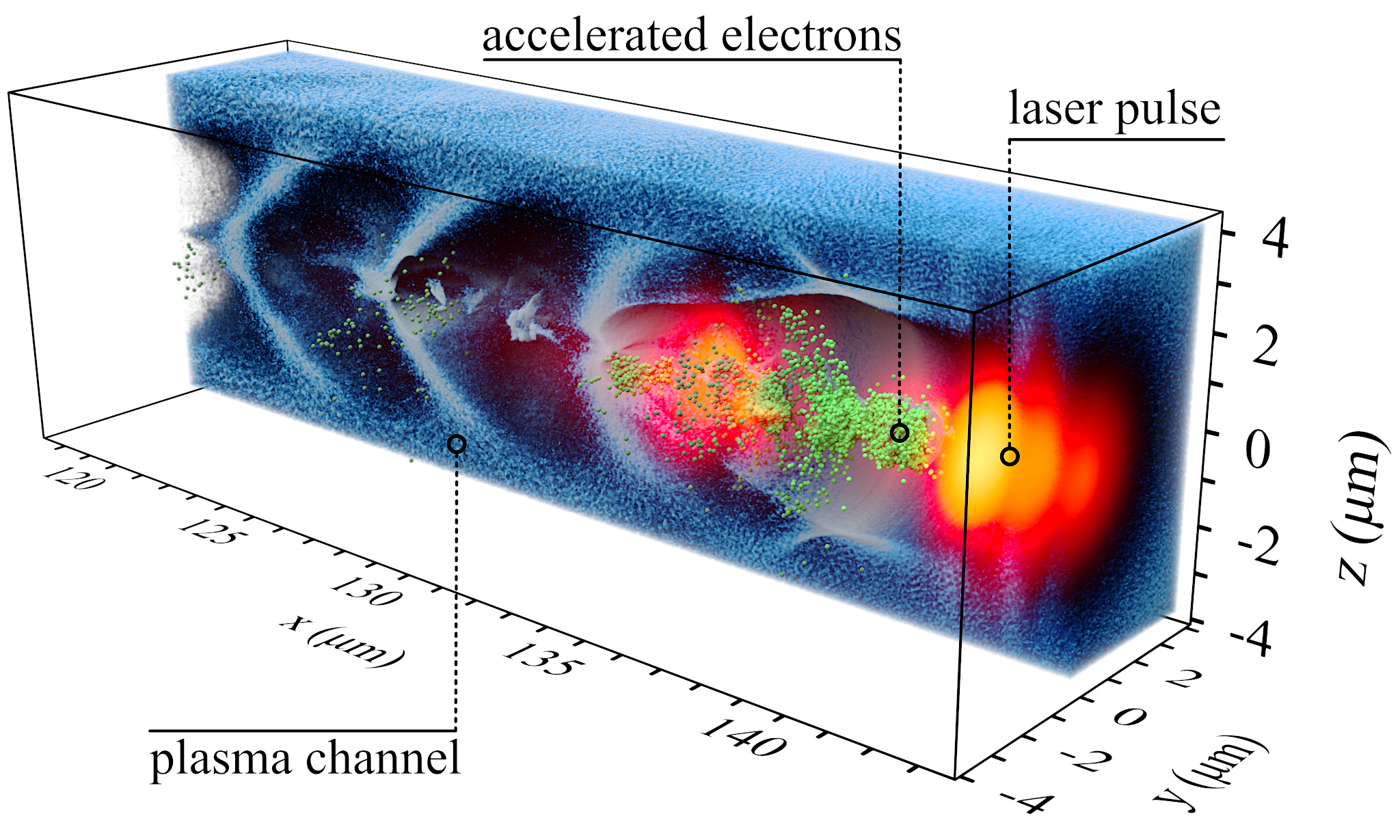
Researchers from the Extreme Light Infrastructure (Czech Rep.) and international collaborators report a detailed numerical study that refines our understanding of self-guided laser wakefield acceleration (LWFA), a technique widely investigated for compact particle accelerators. By combining advanced simulation techniques with Bayesian optimization, the work provides a more systematic view of how key parameters influence electron acceleration and offers practical guidance for experimental setups.
Revisiting the conditions behind laser-plasma interaction
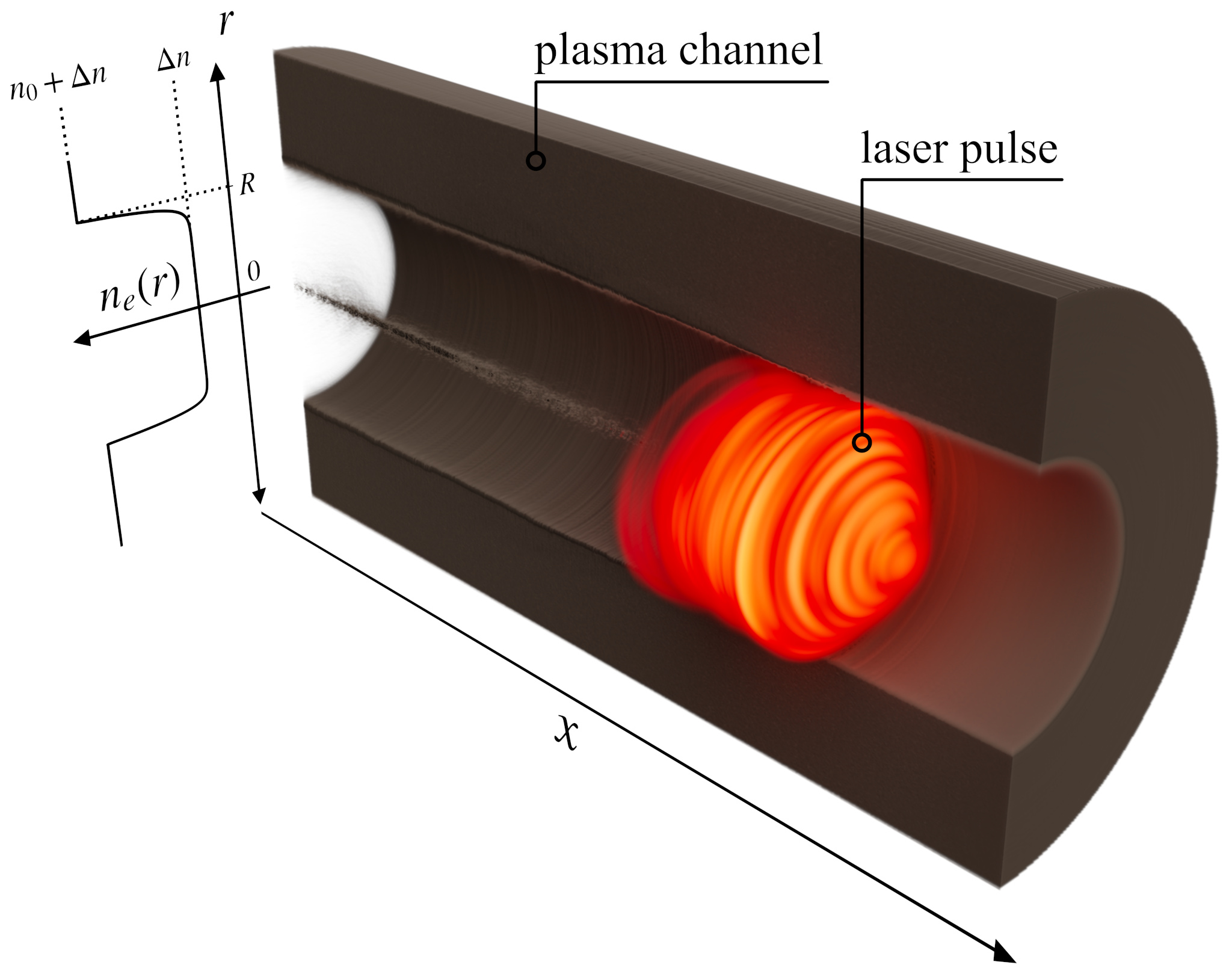
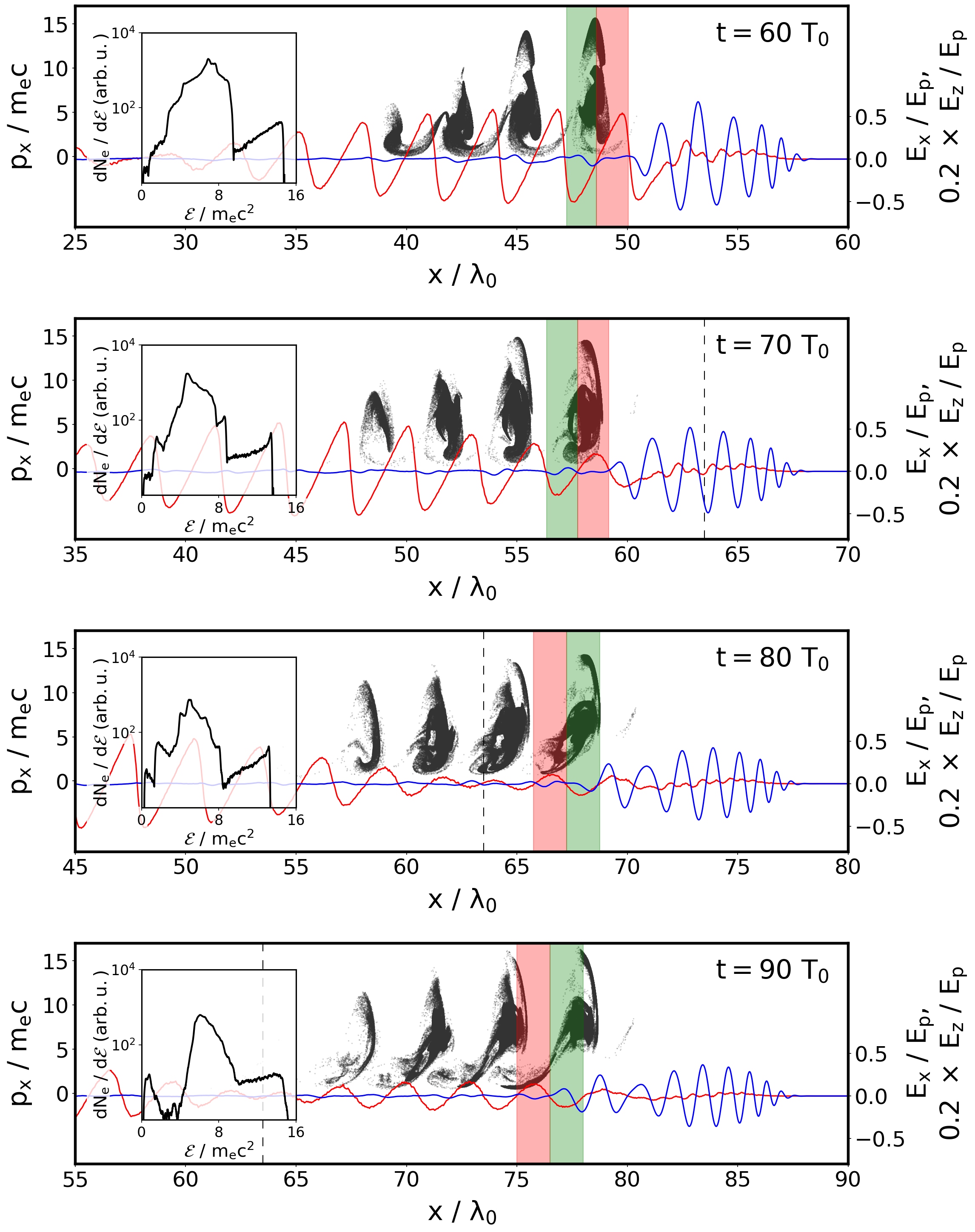
Efficient laser-driven electron acceleration requires the laser pulse to maintain high intensity over distances well beyond the diffraction limit. This makes guiding of the laser pulse in plasma essential. While external guiding is possible, self-guiding is particularly attractive due to its simpler experimental implementation. However, self-guiding operates in a strongly nonlinear regime, where performance depends sensitively on laser and plasma parameters. Achieving high-quality beams therefore relies on a solid understanding of the underlying physics, which is commonly captured in what are known as “matching conditions”. In this work, the authors revisit established theoretical models and extend them by introducing a generalized formulation of the matching conditions. To explore this systematically, they employ large-scale particle-in-cell simulations together with machine learning. This approach allows efficient navigation of a high-dimensional parameter space that would otherwise be computationally prohibitive to study exhaustively.
Mapping the optimal regime for electron acceleration
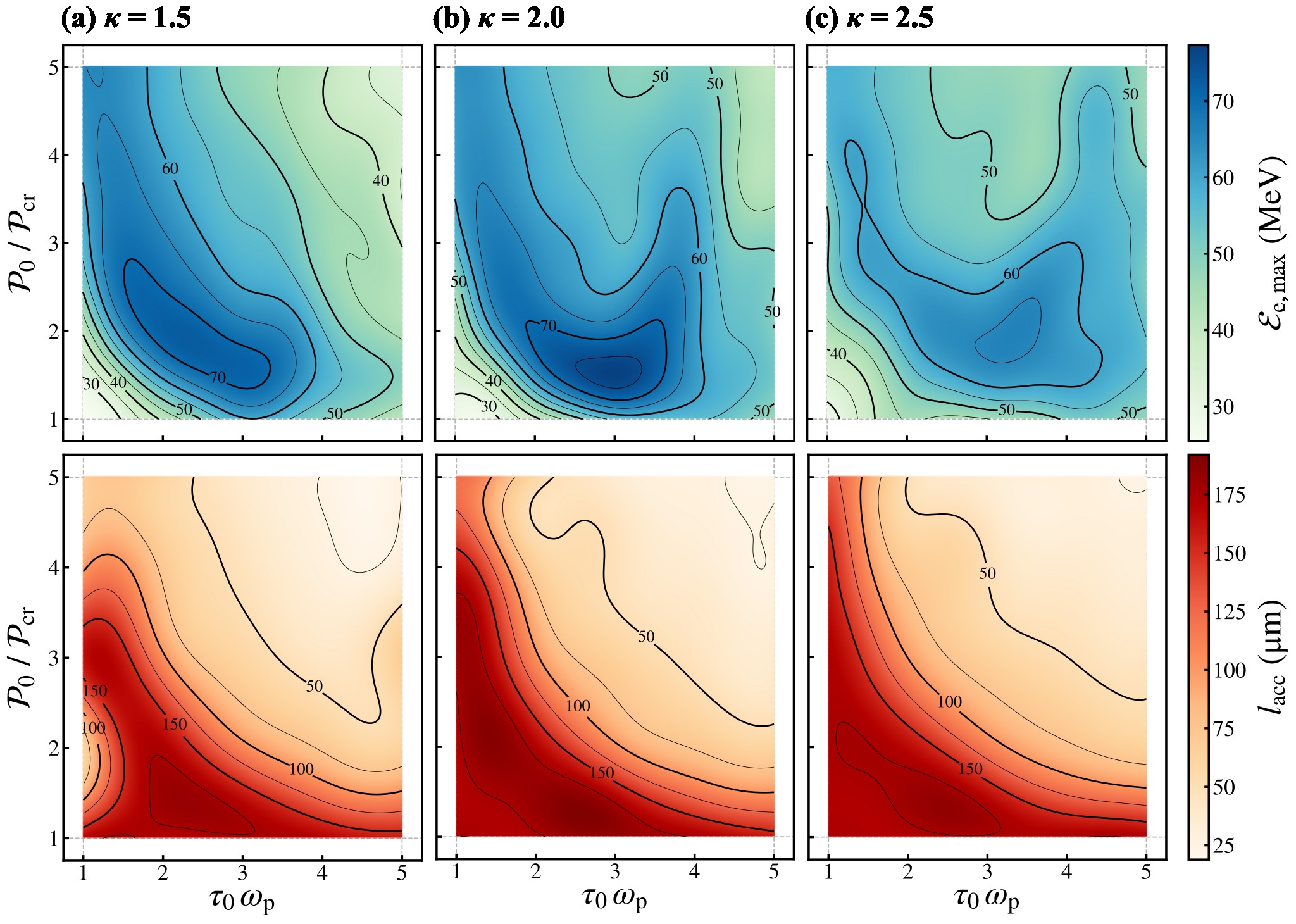
The simulations show that, for a representative 10 mJ laser system, electron energies approaching 80 MeV can be achieved over acceleration distances below 200 micrometers. Rather than identifying a single sharply defined optimum, the results reveal a relatively broad region of parameter space where near-optimal performance is obtained. This region spans variations in laser and plasma parameters, indicating that efficient acceleration actually does not depend on exact parameter tuning. The study also finds that the optimal configuration is close to previously established theoretical models, with only modest adjustments required. This consistency helps validate earlier models while highlighting the importance of accounting for self-consistent laser–plasma evolution. Figure 1 illustrates how the maximum electron energy and the corresponding acceleration distance vary smoothly across the explored domain and how the high-performance regime forms a continuous region rather than a single point.
Implications for experiments and future studies
The results provide practical insights for designing and operating LWFA experiments. The identification of a broad operational window suggests that experiments may be more tolerant to fluctuations in laser and plasma conditions than previously assumed. At the same time, the work demonstrates the value of combining high-fidelity simulations with data-driven optimization techniques. This approach enables a more comprehensive understanding of complex physical systems and can be extended to include additional factors such as electron beam quality, injection mechanisms, or more advanced laser configurations. While the present study focuses on a relatively low-energy laser system, the use of dimensionless parameters suggests that the findings are relevant across a wider range of experimental conditions. This provides a useful foundation for future investigations targeting higher energies or application-specific optimization. Overall, the work contributes to a more systematic and quantitatively grounded understanding of LWFA, supporting ongoing efforts to develop compact, tunable particle acceleration technologies for scientific, medical, and industrial applications.
Tip: Following the principles of reproducible science, the raw data used for this research are openly available on Zenodo and the data analysis can be accessed on GitHub.
How to cite
P. Valenta, K. G. Miller, B. K. Russell, M. Lamač, M. Jech, G. M. Grittani and S. V. Bulanov, “Optimized matching conditions for self-guided laser wakefield accelerators”, Machine Learning: Science and Technology 7, 025030 (2026).
@article{ae51e0,
  title = {Optimized matching conditions for self-guided laser wakefield accelerators},
  author = {Valenta, P. and Miller, K. G. and Russell, B. K. and Lamač, M. and Jech, M. and Grittani, G. M. and Bulanov, S. V.},
  journal = {Machine Learning: Science and Technology},
  volume = {7},
  issue = {2},
  pages = {025030},
  numpages = {14},
  year = {2026},
  month = {Mar},
  publisher = {IOP Publishing},
  doi = {10.1088/2632-2153/ae51e0},
  url = {https://doi.org/10.1088/2632-2153/ae51e0}
}
References
[1] P. Valenta, K. G. Miller, B. K. Russell, M. Lamač, M. Jech, G. M. Grittani and S. V. Bulanov, “Optimized matching conditions for self-guided laser wakefield accelerators”, Machine Learning: Science and Technology 7, 025030 (2026).